2L Jewelry Vacuum Investing & Casting Machine with Built-In 3 CFM Pump
Short Product Description
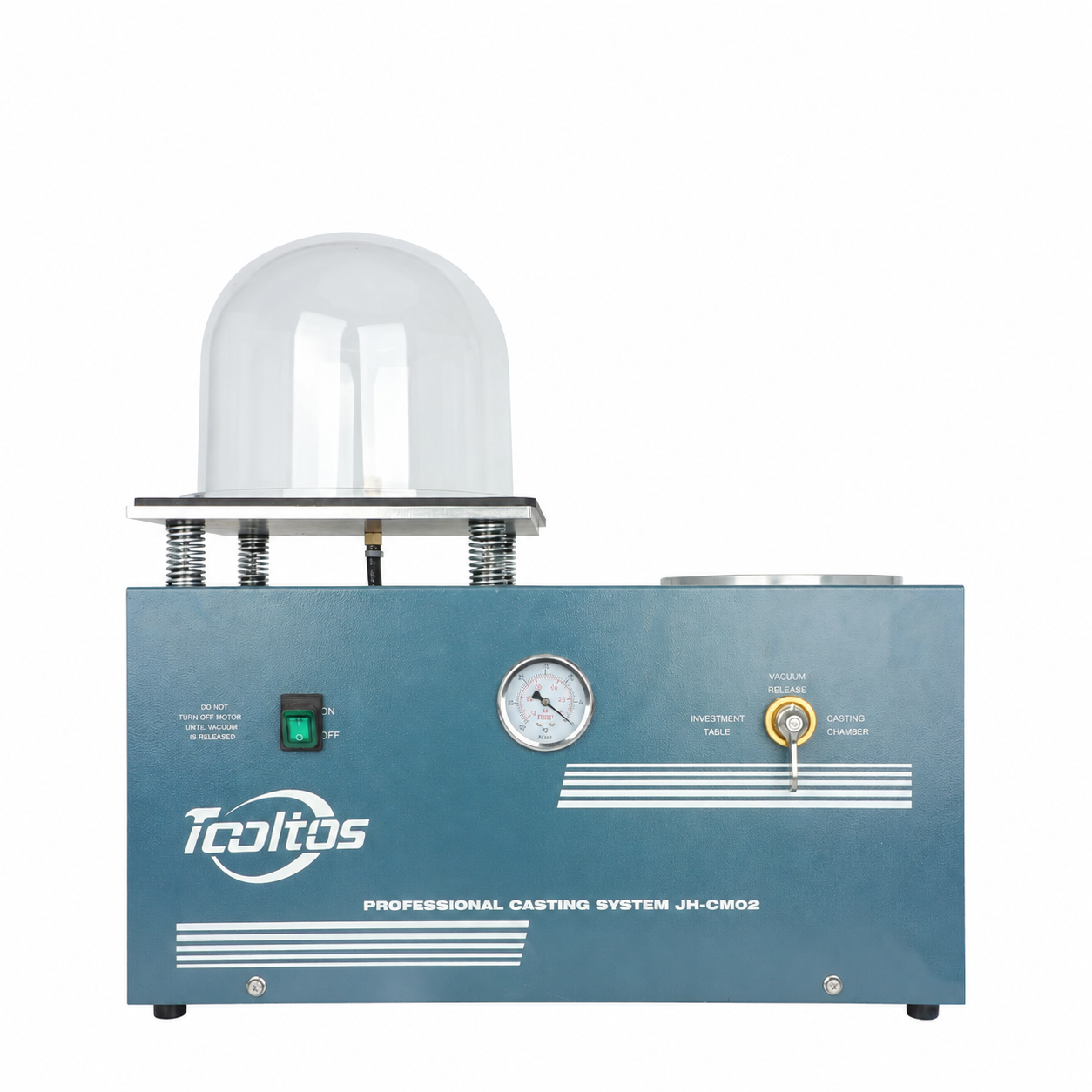
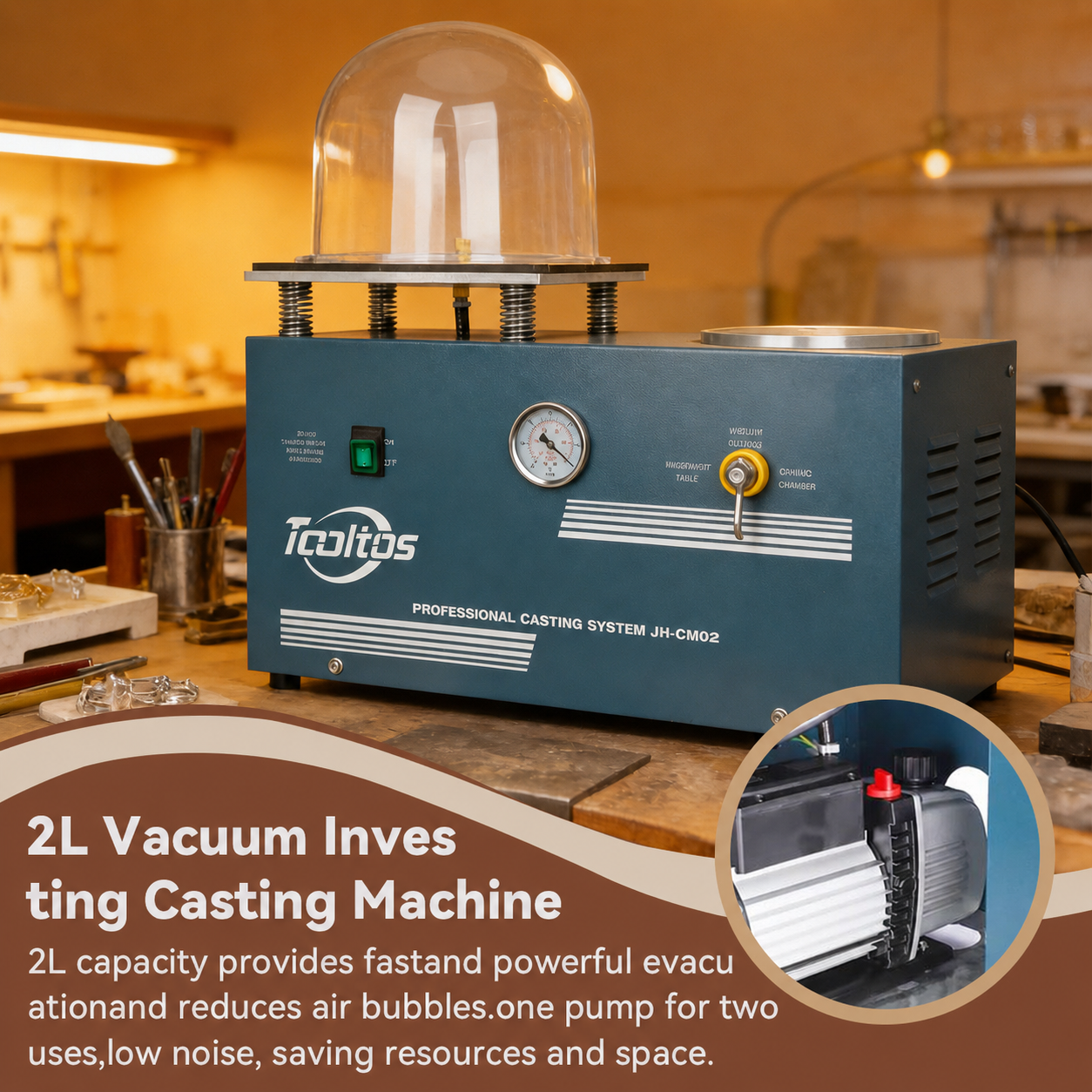
A compact two-function vacuum system for jewellery investment preparation and vacuum-assisted casting. The built-in 3 CFM oil-lubricated pump serves both the 280 × 280mm investing table and the separate casting chamber, helping remove trapped air from investment slurry and support improved mold filling during metal casting.
A separate burnout furnace and metal melting furnace are required. Vacuum pump oil must be added before first use and is not included.
Function 1: Vacuum Investing
Vacuum investing is carried out on the left-hand table beneath the clear acrylic hood.
Basic Workflow
Mix the investment material according to the manufacturer’s water-to-powder ratio.
Place the mixing container on the investing table.
Check that the hood gasket is clean and correctly positioned.
Place the acrylic hood evenly over the container.
Select the investing-table position.
Start the vacuum pump.
Monitor the investment as it rises and releases trapped air.
Release the vacuum before lifting the hood.
Pour the investment into the prepared flask.
Degas the filled flask again if required by the investment manufacturer.
Important
Do not overfill the mixing container. Investment material entering the vacuum line may damage the machine.
Function 2: Vacuum-Assisted Casting
Vacuum-assisted casting is performed using the right-hand casting chamber.
Basic Workflow
Complete the wax burnout cycle in a separate burnout furnace.
Preheat the flask according to the investment and alloy requirements.
Install the correct gasket or adapter on the casting chamber.
Position the hot perforated flask securely.
Select the casting-chamber position.
Start the vacuum pump and confirm that vacuum is developing.
Melt the metal using a separate melting furnace.
Pour the molten metal into the flask while maintaining the required vacuum.
Stop the pump after the appropriate casting interval.
Release the vacuum before removing the flask.
Actual temperatures, timing and pouring procedures must follow the investment material, flask and alloy manufacturer’s instructions.
What This Machine Does and Does Not Do
|
Function |
Suitable? |
Explanation |
|
Vacuum degassing mixed investment |
Yes |
Uses the investing table and acrylic hood |
|
Degassing a filled casting flask |
Yes |
Subject to suitable container and sealing arrangement |
|
Vacuum-assisted jewellery casting |
Yes |
Uses the separate casting chamber |
|
Removing air beneath a perforated flask |
Yes |
Requires compatible flask and gasket |
|
Melting gold, silver or other metals |
No |
Separate melting furnace required |
|
Wax burnout |
No |
Separate burnout furnace required |
|
Flask preheating |
No |
Separate burnout furnace required |
|
Pressure casting |
No |
This is a vacuum system, not a positive-pressure casting machine |
|
Oil-free pump operation |
No |
Vacuum pump oil is required |
|
Unrestricted continuous industrial production |
Not confirmed |
Duty cycle should be confirmed before high-volume use |
Technical Specifications
|
Specification |
Details |
|
Product Type |
Vacuum investing and vacuum-assisted casting machine |
|
Model Classification |
2L |
|
Built-In Pump |
Oil-lubricated vacuum pump |
|
Air Displacement |
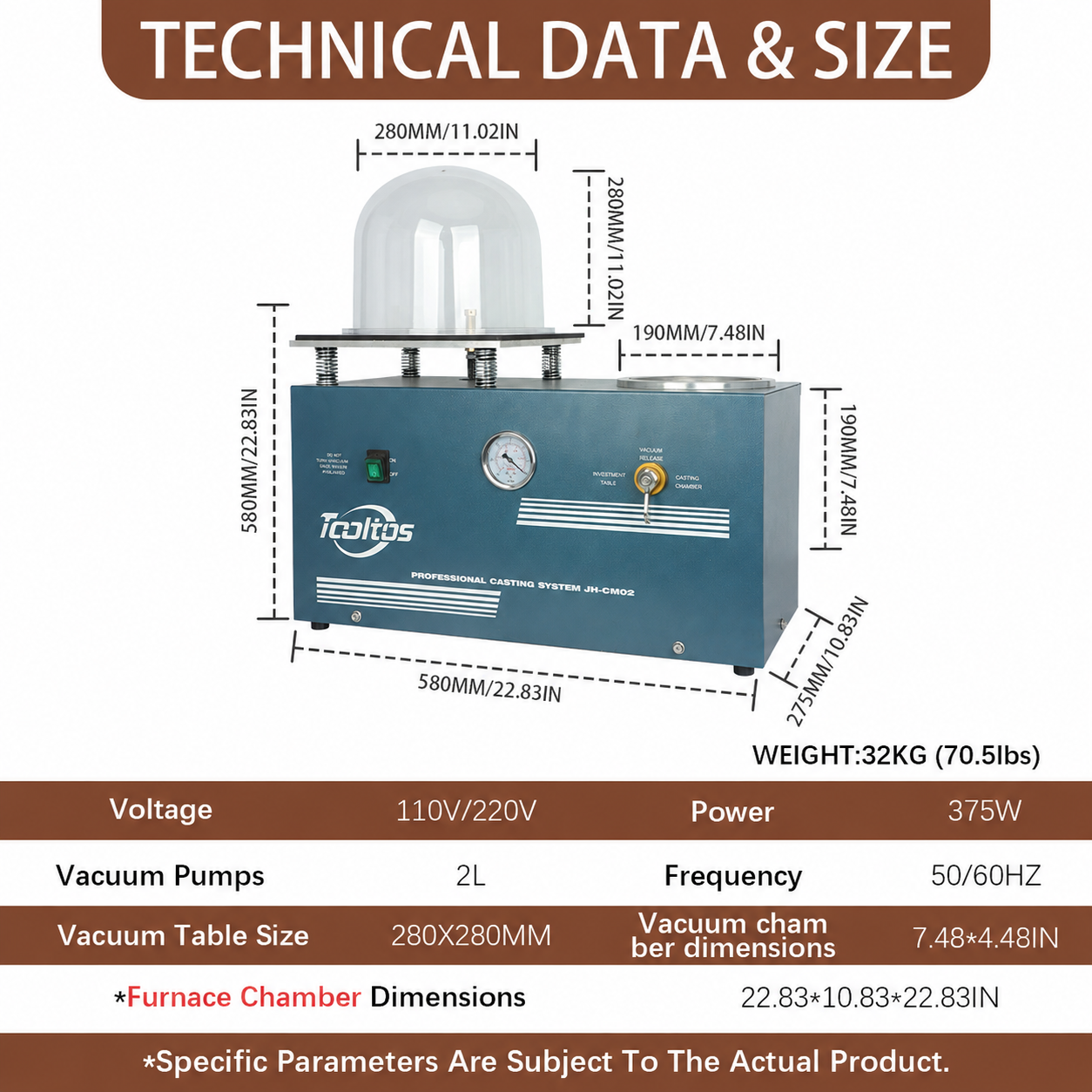
3 CFM / approximately 5.1m³/h |
|
Rated Power |
375W |
|
Voltage Options |
Separate 110V or 220V versions |
|
Frequency |
50/60Hz, depending on version |
|
Investing Platform |
280 × 280mm |
|
Acrylic Hood |
Approximately Ø280 × 220mm |
|
Vacuum Casting Well |
Approximately Ø150 × 190mm |
|
Maximum Compatible Flask |
Approximately 102 × 178mm / 4 × 7in |
|
Included Flask |
Approximately 89 × 102mm / 3.5 × 4in |
|
Machine Dimensions |
Approximately 580 × 310 × 585mm |
|
Net Weight |
Approximately 32kg |
|
Vacuum Monitoring |
Analogue vacuum gauge |
|
Operating Selection |
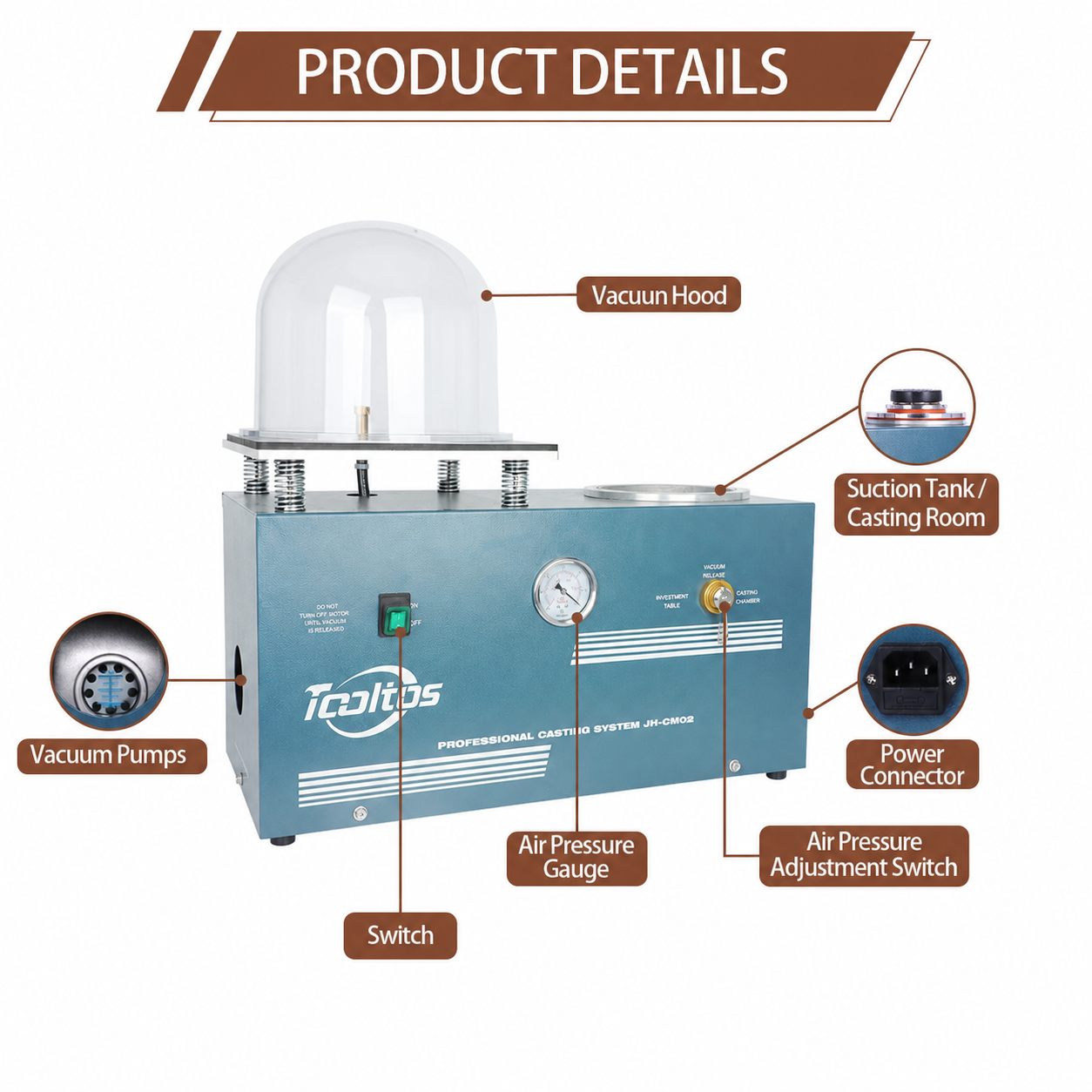
Investing table / vacuum release / casting chamber |
|
Vacuum Pump Oil |
Required; not included |
What’s Included
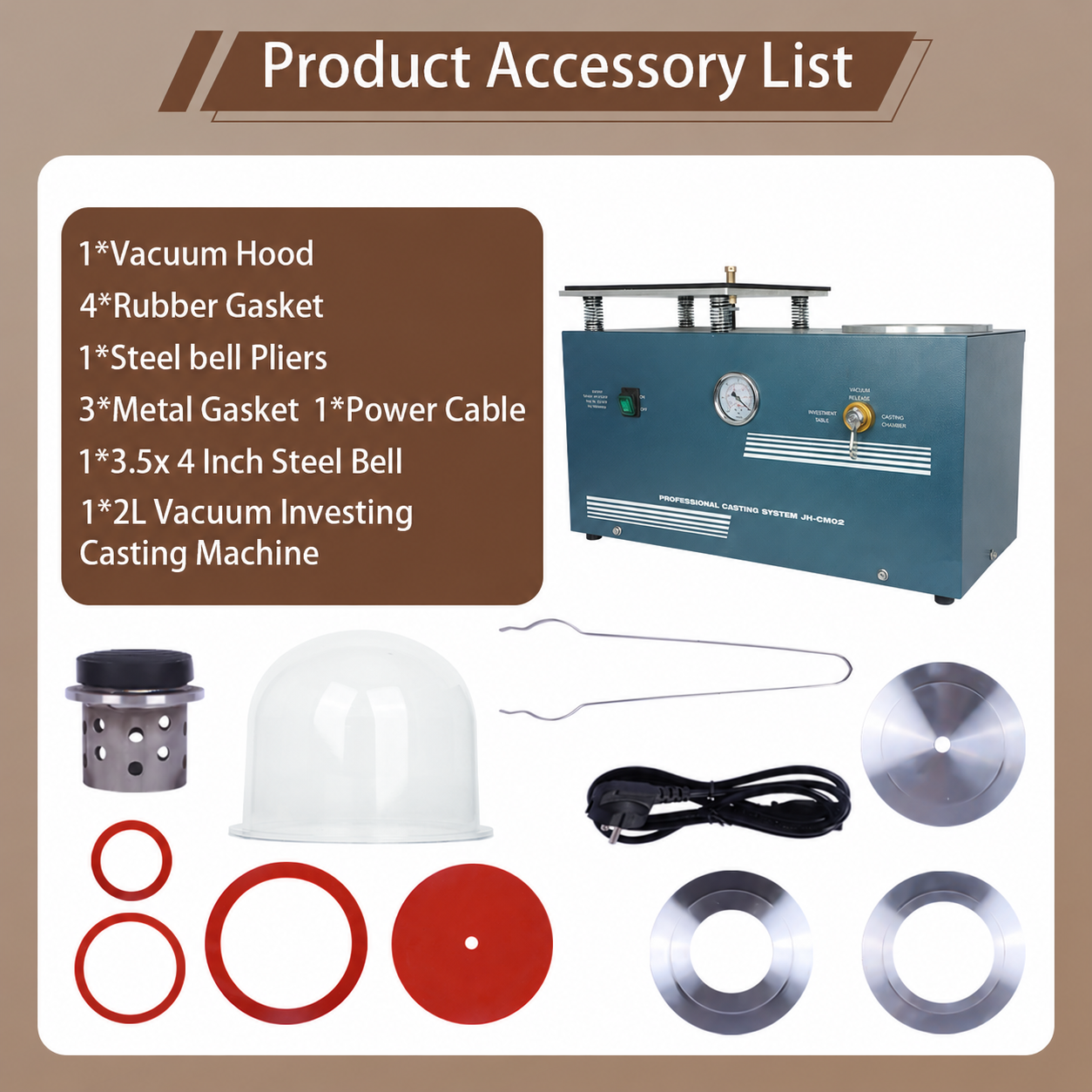
1 × 2L Vacuum Investing & Casting Machine
1 × Clear Acrylic Vacuum Hood
1 × Perforated Stainless Steel Casting Flask, approximately 3.5 × 4in
1 × Casting Flask Lifting Tool
3 × Metal Adapter Plates
4 × Rubber Gaskets
1 × Power Cable
1 × User Manual
Not Included
Vacuum pump oil
Burnout furnace
Metal melting furnace
Investment powder
Casting metal
Additional casting flasks
Heat-resistant personal protective equipment
Before First Use
1. Add Vacuum Pump Oil
Vacuum pump oil is required and is not included.
Do not switch on the machine before the pump has been filled to the correct oil level.
2. Check the Oil Level
The oil level must remain between the minimum and maximum markings shown in the inspection window.
3. Confirm the Voltage
Check the machine rating label and workshop supply before connecting power.
4. Inspect the Acrylic Hood
Do not use the hood if it is cracked, heavily scratched, distorted or otherwise damaged.
5. Check All Gaskets
Clean the sealing surfaces and confirm that the correct gasket or adapter is installed.
6. Test the Vacuum Empty
Before processing investment or pouring metal, run a short empty test to confirm that the gauge responds and the system holds vacuum.
Important Safety Information
Add the correct vacuum pump oil before starting the machine.
Never operate the pump without oil.
Install the machine on a stable, level and load-bearing workbench.
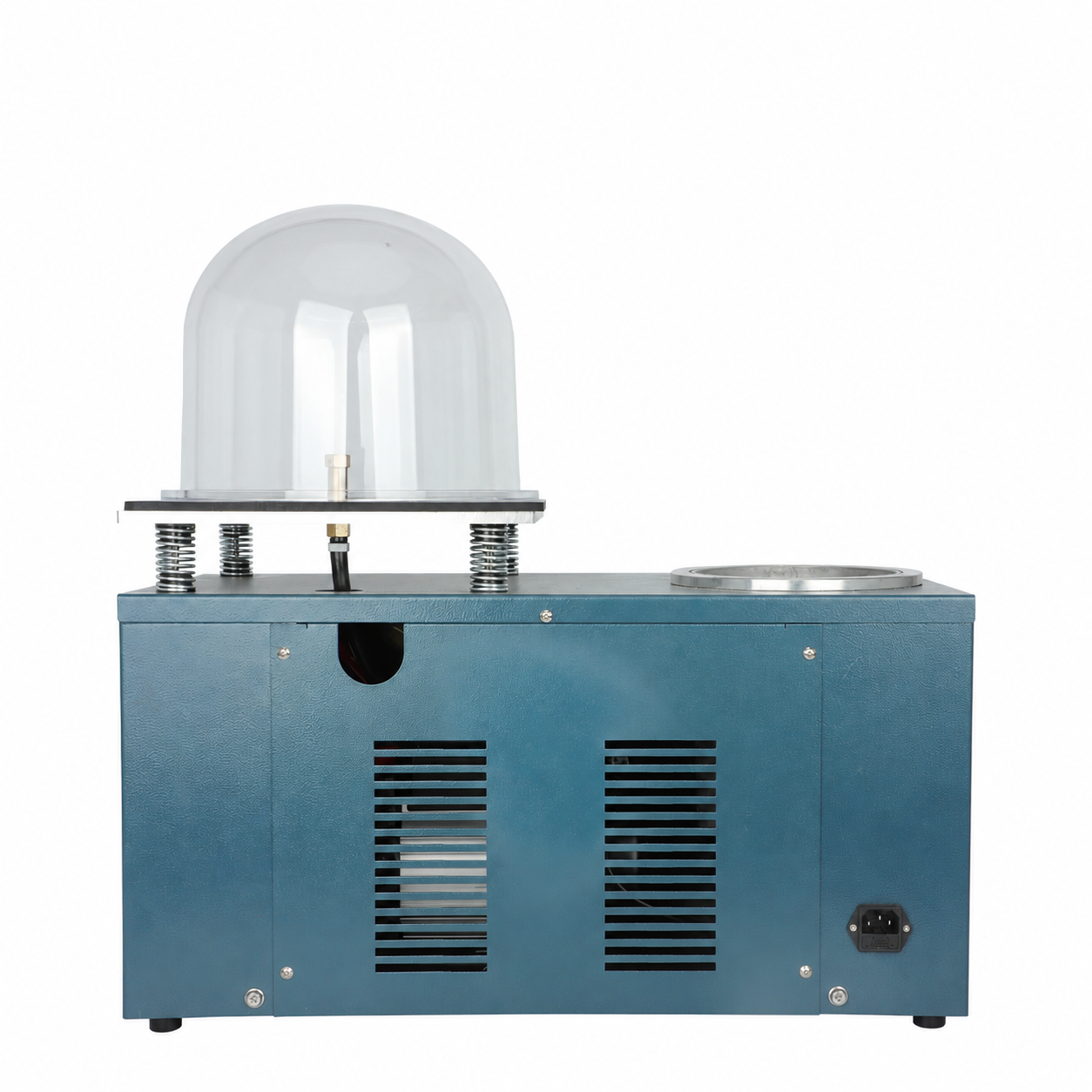
Keep all ventilation openings unobstructed.
Release the vacuum completely before lifting the acrylic hood.
Never force the hood open while the chamber is under vacuum.
Inspect the hood for cracks before every use.
Do not place your face directly above the hood during evacuation.
Use a container large enough to accommodate investment expansion.
Prevent investment slurry, powder and debris from entering the vacuum connection.
Use heat-resistant gloves, face protection and suitable flask tongs during casting.
Ensure that hot flasks are stable and correctly sealed before metal pouring.
Do not touch the casting chamber, flask, adapter plates or surrounding surfaces while hot.
Keep combustible materials away from the casting area.
Use the machine in a properly ventilated jewellery workshop.
Disconnect power before cleaning, draining oil or carrying out maintenance.
Confirm the recommended operating and cooling cycle before repeated production use.
12、FAQ
Frequently Asked Questions
Can this machine actually be used for vacuum casting?
Yes. The machine has a separate vacuum casting chamber in addition to the investing table. It can apply vacuum beneath a compatible perforated flask during metal pouring.
It does not melt the metal or heat the flask.
Can it remove air from investment slurry?
Yes. Place the investment container on the left-hand table and cover it with the clear acrylic hood before applying vacuum.
Does it include a vacuum pump?
Yes. A 3 CFM oil-lubricated vacuum pump is built into the machine.
Is vacuum pump oil included?
No. Vacuum oil must be purchased separately and added before first use.
What type of vacuum oil should I use?
Use the vacuum pump oil grade specified in the supplied manual or confirmed by Tooltos support. Do not use automotive engine oil or an unapproved substitute.
Can it melt gold or silver?
No. A separate metal melting furnace is required.
Do I still need a burnout furnace?
Yes. The flask must be burned out and preheated in a separate burnout furnace before vacuum casting.
What is the maximum flask size?
The casting chamber is listed as approximately Ø150 × 190mm and supports compatible flasks up to approximately 102 × 178mm, or 4 × 7in.
Flange size, gasket configuration and handling clearance must also be considered.
What flask is included?
One perforated stainless steel casting flask measuring approximately 89 × 102mm, or 3.5 × 4in, is listed as included.
Can I use a solid flask?
This machine is primarily configured for compatible perforated casting flasks. Compatibility with solid flasks depends on the adapter and sealing arrangement and should be confirmed before purchase.
What does the centre selector do?
It directs the vacuum between:
The investing table
The vacuum-release position
The casting chamber
Does the gauge adjust the vacuum?
No. The analogue gauge monitors vacuum level. The selector controls the vacuum path; the gauge itself is not an adjustment control.
Can I lift the acrylic hood immediately after stopping the pump?
No. Move the control to the vacuum-release position and wait until the gauge returns before lifting the hood.
Is this suitable for continuous factory production?
The 2L model is better positioned for small studios and small-batch work. Its continuous-duty cycle should be confirmed before high-volume production.