


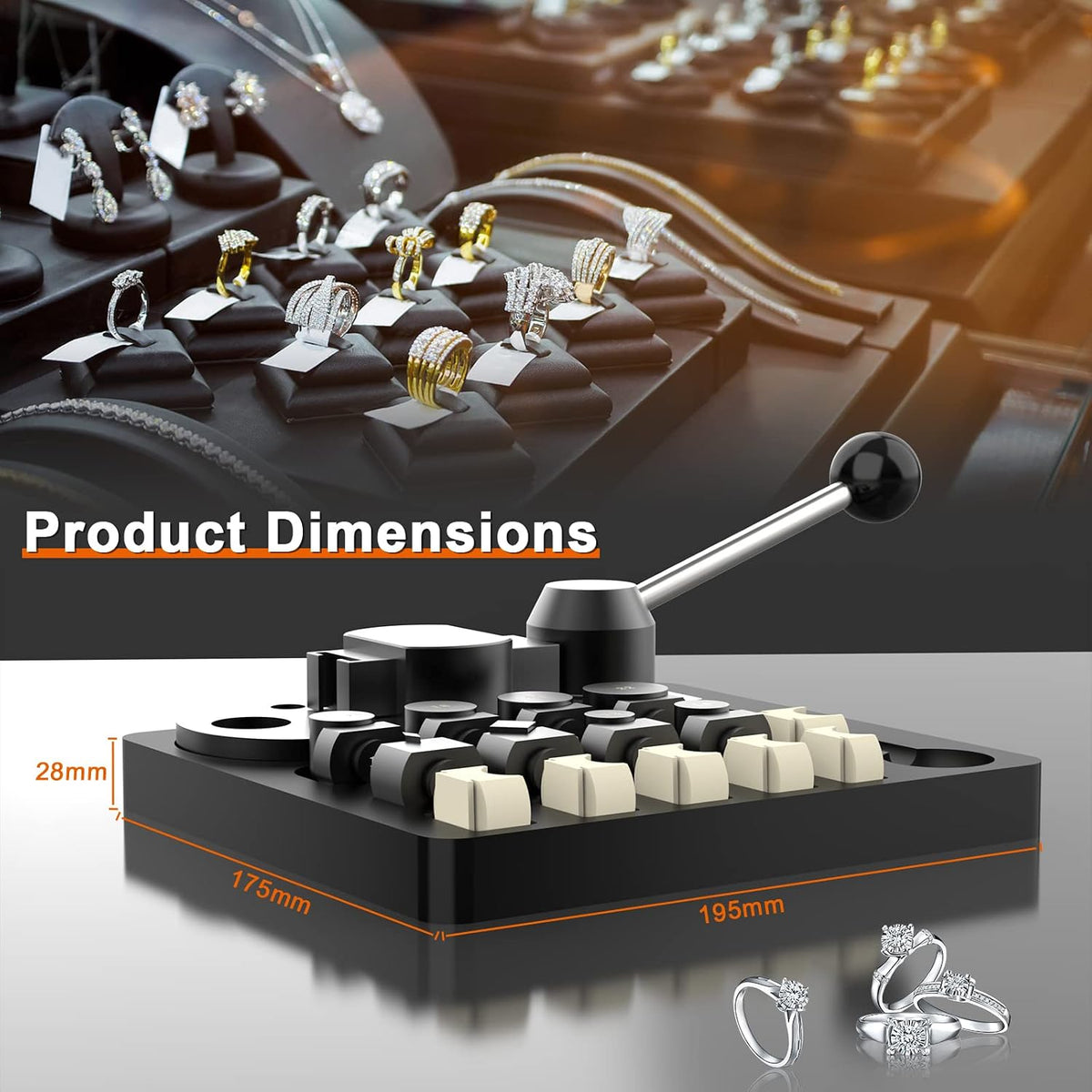


Ring Bending Tool for Jewelry Forming
Form Soft Metal Blanks into Rings and Jewelry Curves
This manual ring bending tool set uses interchangeable steel forming dies and nylon inserts to bend soft metal blanks into curved profiles. The lever operated bender supports ring making, earring components and other small jewelry forming tasks, while the included sizing and finishing accessories support work at the bench.
Select a forming profile, secure the bender to a stable bench and bend the blank gradually. Nylon inserts provide a softer contact surface for delicate material, but surface condition, metal hardness and technique still affect marking.
What's Included
- Manual ring bender with lever handle and storage base
- Steel round forming dies and matching blocks
- Angle forming dies for 60 degree and 90 degree bends
- Nylon forming inserts
- Dual face jewelry mallet
- Graduated ring mandrel and wooden forming mandrel
- Ring sizing gauge set and adjustable sizing bands
- Finishing and polishing accessories, including cloths
- Hex keys and mounting hardware
Metal and Die Selection Guide
Use this tool for soft precious metal blanks and other suitably soft jewelry stock less than 3 mm (0.118 in) thick. This is a material guideline, not a guarantee for every alloy or blank width. Hard metal, wide sections and work hardened stock can require substantially more force. Stop if the handle resists unexpectedly rather than using an extension bar.
The round dies are marked 12, 14, 16, 18, 20 and 22 mm (0.472, 0.551, 0.630, 0.709, 0.787 and 0.866 in). These are forming die dimensions, not finished finger sizes. Check the ring on a sizing mandrel after bending and account for the blank thickness and springback.

Best For and Not For
| Best For | Not For |
|---|---|
| Jewelry makers forming soft metal ring blanks | Steel stock, hardened alloys or forcing resistant material |
| Bench jewelers making repeatable curves and angular jewelry components | Guaranteed finished ring sizes based only on die markings |
| Hobbyists forming suitable earring and small jewelry components | Bending stone set rings or delicate mounted gemstones |
| Makers using nylon inserts to reduce direct metal contact | A guarantee of mark free forming on every surface |
Technical Specifications
| Operation | Manual lever operated bending |
| Forming components | Steel dies and white nylon inserts |
| Round die markings | 12, 14, 16, 18, 20 and 22 mm (0.472, 0.551, 0.630, 0.709, 0.787 and 0.866 in) |
| Angle profiles | 60 degrees and 90 degrees |
| Recommended stock | Soft jewelry metal less than 3 mm (0.118 in) thick |
| Base dimensions shown | Approximately 195 × 175 × 28 mm (7.68 × 6.89 × 1.10 in), excluding raised mechanism and handle |
| Package weight shown | Approximately 3 kg (6.61 lb) |
| Mounting | Bench mounting with supplied hardware |
Pro Tips
- Fasten the bender to a stable workbench before applying leverage.
- Choose a die and matching block appropriate for the intended curve and blank.
- Test on an offcut of the same material before forming a finished component.
- Make small progressive bends and check alignment and springback frequently.
- Keep dies and nylon contact surfaces free of grit, and keep fingers clear of pinch points.
FAQ
1. Can this tool bend any metal up to 3 mm thick?
No. The recommendation is for soft jewelry metal less than 3 mm (0.118 in) thick. Alloy, temper and width also affect the force required. Do not force hard or resistant stock.
2. Do the die numbers correspond to finger sizes?
No. They describe the forming die dimensions. Check the finished ring size separately with a suitable mandrel and gauge.
3. Will the nylon inserts prevent all marks?
No. They provide a softer contact surface, but debris, pressure and the material finish can still cause marks. Test on scrap first.
4. Can it make earrings as well as rings?
Yes. It can form suitable soft metal earring components and other small jewelry curves within the available die profiles.
5. Does the bender need to be mounted?
Secure it to a stable workbench before use. Mounting hardware is included, and the bench must be suitable for the applied leverage.
6. Who can help with material or accessory questions?
Contact the Musttool team at musttool01@gmail.com with questions about die selection, included accessories or an existing order.
Support
Questions about ring bending materials, die selection or order status? Contact the Musttool team at musttool01@gmail.com. We respond within 24 hours on business days.